
Extended Reality in Real Estate: A Strategic Advantage for Enterprise Leaders

The real estate sector is evolving and changing rapidly. For years, this sector has been properly dependent on physical site visits on motionless 2D photographs. But a few years back, digital transformation sped up, and agents and enterprise leaders turned towards extended reality (XR) in real estate to gain a competitive edge. Combining the virtual and real-life, XR is not only a futuristic idea but also a business instrument that simplifies business processes, increases the trust of buyers, and reduces the time it takes to sell goods.
Mastering the Market with Extended Reality in Real Estate
Mastering the Market with Extended Reality in Real Estate
The major issue has always been the imagination gap in the case of enterprise leaders. A blueprint or an empty shell frequently fails to enable the potential buyer or investor to envision the completed project. This is where the XR solution transforms the game completely. The combination of Virtual Reality (VR), Augmented Reality (AR), and Mixed Reality (MR) would allow developers to offer stakeholders a deeper experience than just visuals.
Bridging the Imagination Gap with Immersive Technology
An XR solution can be utilized in order to introduce real-time customization. As long as a client makes a virtual walkthrough, he or she can make changes to flooring materials, wall color, or furnishing layouts with a single click. The degree of interactivity creates the feeling of ownership and emotional attachment much earlier than the construction of the first brick. Such a development of XR in Real Estate makes sure that all stakeholders have the same vision on the final product.
Operational Efficiency Through Extended Reality in Real Estate
Implementing the new technology implies a wider scope than procuring equipment, as it presupposes a partnership with the specialists familiar with the specifics of spatial computing. By incorporating professional XR services into the business model of the real estate industry, one will be confident in the fact that digital twins of properties are precise, high-fidelity, and scalable.
An XR solution can be utilized in order to introduce real-time customization. As long as a client makes a virtual walkthrough, he or she can make changes to flooring materials, wall color, or furnishing layouts with a single click. The degree of interactivity creates the feeling of ownership and emotional attachment much earlier than the construction of the first brick. Such a development of XR in Real Estate makes sure that all stakeholders have the same vision on the final product.
Operational Efficiency Through Extended Reality in Real Estate
Implementing the new technology implies a wider scope than procuring equipment, as it presupposes a partnership with the specialists familiar with the specifics of spatial computing. By incorporating professional XR services into the business model of the real estate industry, one will be confident in the fact that digital twins of properties are precise, high-fidelity, and scalable.
Optimizing Operations Through Advanced Digital Integration
The advantages of using XR services for enterprises are the decreased necessity to organize real physical staging and site visits. To an international investor, the fact that one can view a property half a world away in high definition is priceless. This minimizes the amount of carbon footprint involved in traveling as well as the overhead expenses incurred by the brokerage firms and developers.
Higher Conversions via Extended Reality in Real Estate
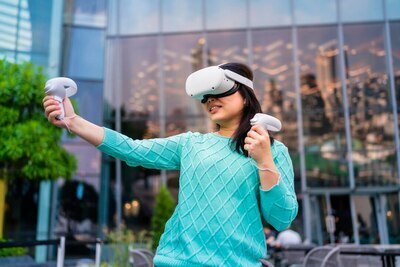
The most realistic effect of this technology change is on the performance of sales. VR in Real Estate has easily turned out to be a game-changer. VR is also a sense of presence and scale as opposed to traditional photos. As soon as a lead puts on a headset, they stop seeing a house; they are in their future house.
The most realistic effect of this technology change is on the performance of sales. VR in Real Estate has easily turned out to be a game-changer. VR is also a sense of presence and scale as opposed to traditional photos. As soon as a lead puts on a headset, they stop seeing a house; they are in their future house.
Driving High-Stakes Conversion with Virtual Environments
Tactically, VR in Real Estate enables the pre-selling of properties during the development stage more than ever before. Through the try-before-you-buy experience, the enterprise leaders will be able to raise funds and promises earlier in the project life cycle, drastically increasing the cash flow and decreasing market risk.
Future-Proofing Assets with Extended Reality in Real Estate
As a strategic concern, VR in Real Estate presents an unprecedented success in pre-selling the properties under development. Enterprise leaders can raise funds and investment guarantees earlier in the life cycle of the project by offering a try-before-you-buy experience, which has a tremendous impact on cash flow and minimizes market risk.
As a strategic concern, VR in Real Estate presents an unprecedented success in pre-selling the properties under development. Enterprise leaders can raise funds and investment guarantees earlier in the life cycle of the project by offering a try-before-you-buy experience, which has a tremendous impact on cash flow and minimizes market risk.
Scalability and Data Insights for Future Growth
To actually conquer the market, companies should not be satisfied with basic 360-degree videos but should implement advanced VR Solutions. These systems provide multi-user systems in which an agent, a client, gives a tour in the same virtual space in New York to a client in London.
To actually conquer the market, companies should not be satisfied with basic 360-degree videos but should implement advanced VR Solutions. These systems provide multi-user systems in which an agent, a client, gives a tour in the same virtual space in New York to a client in London.
Final Thoughts
VR Solutions of enterprise-grade also offer good data analytics. Leaders will be able to monitor the places within a virtual model that a client spends the most time and make changes in their architecture or marketing orientation based on data. Such awareness was previously not possible within the traditional real estate model, and this is the further dynamism of XR in Real Estate as the ultimate decision-making tool.
Since the industry is turning to a more digitized future, VYUG Metaverse does not necessarily see Extended Reality as a marketing frivolity but as the primary framework of the future of property trade.